3D puff embroidery: logos with altitude
Foam under dense stitching raises your mark off the panel — decoration you can read across a room and feel with a thumb. It's the highest-impact technique in embroidery, and the most demanding to execute well.
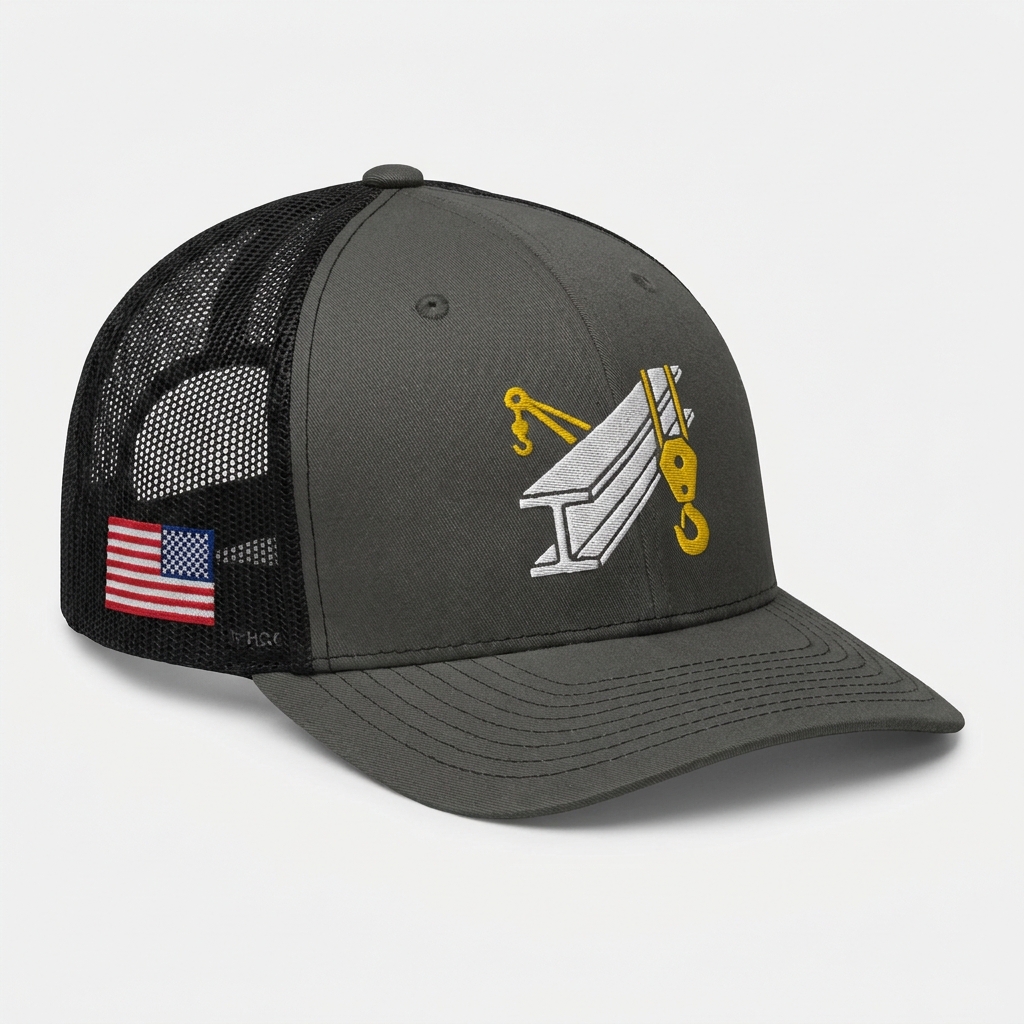
Sharp puff is a sequencing problem
Puff fails at the edges. High-tension stitching over foam on a curved, assembled cap pulls, puckers, and rounds off — which is why so much puff in the market looks soft. Our panels are embroidered flat, before the cap is sewn together. On a flat panel the foam compresses evenly, the satin stitches lock clean at the perimeter, and the letterform keeps its geometry. The technique is not exotic; the sequence is. It requires embroidery and cap assembly on the same production line.
Design rules we enforce at the mockup stage: consistent stroke widths, no fine serifs inside the puffed area, and a minimum line weight the foam can support. Where your logo has secondary detail — a tagline, an established date — we run puff for the primary mark and flat stitch for the rest in a single registered pass. The layered result (raised over flat) reads as intentional design, because it is.
Best-fit formats: flatbills and snapbacks for maximum panel height, structured truckers for program versatility. See also the full puff specification and flat embroidery.
Every puff order follows the standard discipline: free 24-hour mockup with the puff rendered, line-item plain-dollar quote, PMS-matched sewout proof, and a 21-day typical ship window from approval.
High-crown styles built for puff
3D puff questions
A foam layer is placed on the panel and stitched over with dense embroidery; the foam raises the stitching into dimensional relief. The result is a logo with physical height — readable at distance, unmistakable in hand.
Bold shapes and letterforms with consistent stroke width. Fine serifs and small type don't survive the foam's minimum width. Most programs run puff for the primary mark and flat embroidery for secondary text — executed together in one pass.
Puff requires dense, high-tension stitching, which distorts on a curved, assembled cap. Embroidering panels flat before assembly compresses the foam evenly and keeps edges clean — a sequence advantage, not an equipment claim.
See your mark raised
Send the logo. The 24-hour mockup shows the puff at production scale, with any needed art adjustments flagged up front.
Start your quote